 how-to
5 Laser Resurfacing Recovery Signs at One Month
Last Updated: October 28, 2026
Quick Summary
By one month, laser resurfacing recovery usually means the surface has closed over and the worst peeling is behind you. The skin may still look pink or uneven, and texture changes can keep developing for several months.
- Most visible peeling and crusting happens in the first one to two weeks.
- Pinkness that fades week over week at one month is normal healing.
- Redness that worsens, feels hot, or spreads needs prompt medical attention.
- Ablative CO2 often stays pink and tight past week four, while non-ablative treatments recover faster.
- Judge your final result at three to six months, not at four weeks.
Table of Contents
- Laser Resurfacing Recovery Timeline: Where You Should Be at One Month
- Redness After Laser Resurfacing: What Is Normal at One Month
- CO2 Laser Resurfacing Recovery Compared to Other Laser Types
- Skin Care After Laser Resurfacing in the First Month
- Normal Healing Versus Warning Signs at One Month
- Realistic Results at One Month and Booking Your Follow-Up With Bella MedSpa
- Frequently Asked Questions
Laser Resurfacing Recovery Timeline: Where You Should Be at One Month
Laser resurfacing recovery is usually the question people ask most at the one-month mark, and it's a fair one. Some people expect their skin to look finished by week four. Healing timelines vary. Laser resurfacing recovery follows a predictable arc, but the details vary by treatment type and depth.
Most patients see the worst of the visible peeling and crusting in the first one to two weeks. By one month, the surface has usually closed over. The skin may still look pink or slightly uneven, and fine texture changes can continue for several months.
Keep this in mind: one month is a checkpoint, not a finish line. Your provider will tell you what your timeline should look like based on how your skin was treated.
Redness After Laser Resurfacing: What Is Normal at One Month
Redness can be a concern at this stage. Some pinkness at one month is expected after laser resurfacing. The treated skin is still rebuilding its barrier, and blood flow to the area remains higher than before.
A good rule of thumb: redness that is fading week over week is normal. Redness that is getting worse, feels hot to the touch, or comes with spreading swelling needs prompt medical attention.
How long redness and pinkness typically last
Pinkness can persist for several weeks to a few months, depending on treatment depth and your skin's natural response. Deeper treatments generally take longer to settle. Many patients find that makeup can cover the color once the skin is fully closed and gently moisturized.
CO2 Laser Resurfacing Recovery Compared to Other Laser Types
Not all laser resurfacing recovers the same way, and at the one-month mark the differences between treatment types are often the clearest they will ever be. Knowing which category your treatment falls into helps you interpret what you are seeing in the mirror. If you are still deciding whether a beginner laser resurfacing treatment is worth trying, see whether laser skin resurfacing is worth it for beginners.
The two variables that matter most are depth (ablative versus non-ablative) and coverage pattern (fractional versus fully ablative).
Ablative versus non-ablative
Ablative lasers, most commonly fractional or fully ablative CO2 and erbium, remove the entire outer layer of skin (the epidermis) and heat the dermis beneath it. That controlled injury is what drives collagen remodeling, but it also means the skin has to rebuild its surface barrier from scratch. Non-ablative lasers, such as non-ablative fractional 1440 nm or 1550 nm devices and pulsed-dye or IPL-type platforms, leave the epidermis intact and deliver heat below the surface.
At one month, the practical difference is usually visible:
- Ablative CO2: surface typically closed by week one to two, but pinkness, tightness, and a slightly shiny or sensitive texture often persist well into week four and beyond. Makeup may still sit unevenly on dry patches.
- Non-ablative: little to no open skin, mild flaking for a few days, and by one month most patients are back to their normal routine with only faint pinkness in treated areas.
Fractional versus fully ablative
Fractional devices treat only a fraction of the skin surface in a grid of microscopic columns, leaving untreated skin between them to act as a reservoir for healing. Fully ablative treatments cover the entire surface in one pass.
- Fractional CO2: healing is faster because untreated columns help re-epithelialize the treated ones. At one month, most patients are past the peeling stage but may still have a pink or slightly bronzed tone that fades over the following weeks.
- Fully ablative CO2: the whole surface must re-epithelialize, so redness, sensitivity, and tightness at one month are typically more pronounced, and the return to normal skincare and sun exposure is slower.
How to tell which category you had
Ask your provider for the device name and whether the treatment was fractional or fully ablative. That single answer tells you more about your expected one-month appearance than any generic timeline. If you are unsure, bring your treatment record to your follow-up visit.
The table below sums up how the main laser types differ at the one-month mark.
| Laser type | Surface at one month | What to expect |
|---|---|---|
| Ablative CO2 | Typically closed by week one to two | Pinkness, tightness and sensitivity often persist past week four |
| Non-ablative | Little to no open skin | Mild flaking for a few days, faint pinkness by one month |
| Fractional CO2 | Mostly healed by one month | Pink or slightly bronzed tone fades over following weeks |
| Fully ablative CO2 | Whole surface must re-epithelialize | Redness and sensitivity more pronounced, slower return to normal |
Skin Care After Laser Resurfacing in the First Month
Good aftercare protects the new skin while it heals. Keep it simple and gentle during the first month.
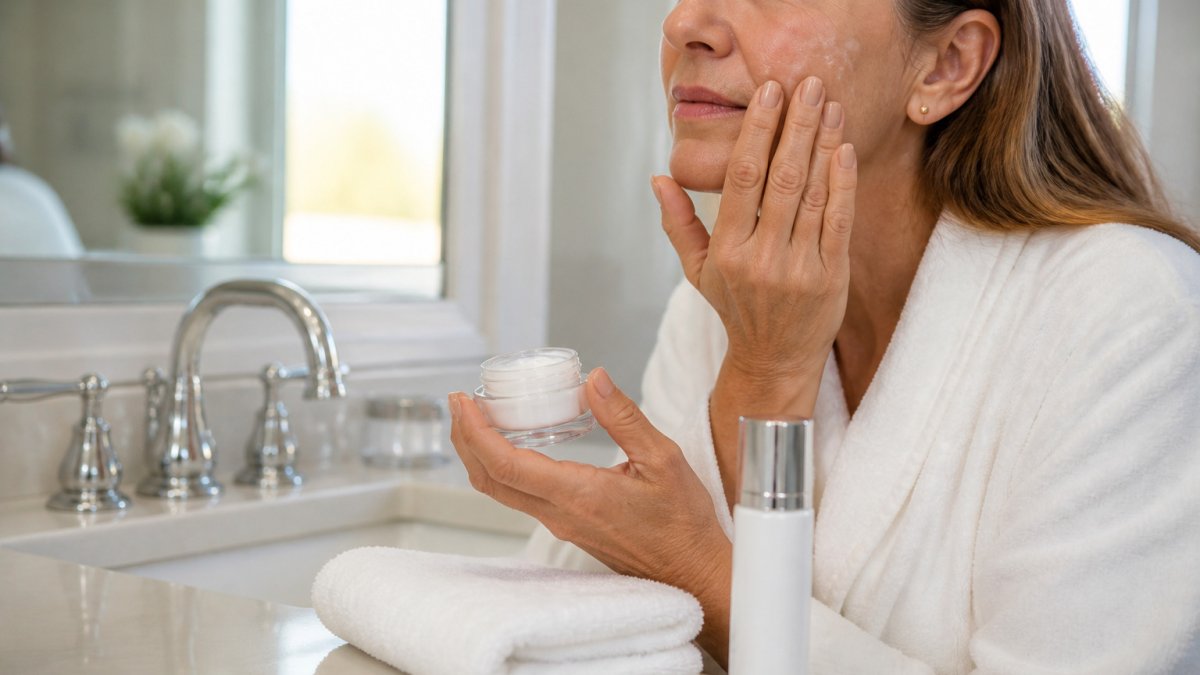
Gentle cleansing, moisturizing and sun protection
- Cleanse gently: use a mild, fragrance-free cleanser with lukewarm water
- Moisturize often: a bland, barrier-supporting moisturizer keeps the skin comfortable
- Protect from the sun: use a broad-spectrum sunscreen daily, since new skin burns easily
- Avoid harsh products: skip exfoliants, retinoids, and strong actives until your provider approves them
Follow the aftercare instructions your provider gives you. They may differ based on your treatment.
Normal Healing Versus Warning Signs at One Month
Knowing the difference between normal healing and a problem helps you act quickly when it matters.
Normal at one month:
- Lingering pinkness that is gradually fading
- Mild dryness or tightness
- Slight unevenness in texture or tone
- Sensitivity to sun, heat, and harsh products
Contact your provider promptly if you notice:
- Increasing redness, warmth, or swelling
- Pus, oozing, or a foul smell
- Severe or worsening pain
- Signs of infection such as spreading redness or fever
Do not wait it out if something feels wrong. Call your provider's office and describe what you are seeing.
Realistic Results at One Month and Booking Your Follow-Up With Bella MedSpa
One month is a checkpoint, not necessarily a final result.
What is actually happening in your skin at one month
By week four, the surface has usually re-epithelialized and the initial peeling and crusting are behind you. Beneath the surface, the real work is still underway. Laser resurfacing triggers a wound-healing cascade that includes new collagen deposition and remodeling of the dermal matrix, and that process unfolds over months, not weeks. The skin you see at one month is a mid-construction site, not a finished room.
Early results versus final results
What patients typically notice at one month:
- Smoother texture in treated areas
- More even tone, though pinkness may still be present
- A slightly 'tight' or shiny quality to the skin
- Fine lines that look softened but not erased
What is still to come:
- Continued fading of pinkness over the following weeks to months
- Further improvement in tone and texture as collagen matures
- A more natural-looking finish once the skin's barrier fully normalizes
A useful rule of thumb: judge your result at three to six months, not at four weeks. If you are comparing before-and-after photos, take them in the same lighting at the same time of day so you are comparing skin, not camera conditions.
What your one-month follow-up is for
A one-month check-in is not a final grade. It is a chance for your provider to:
- Confirm that healing is progressing normally
- Adjust your skincare if you are still dry, sensitive, or breaking out
- Advise on when it is safe to reintroduce retinoids, exfoliants, or other actives
- Discuss whether a second session (if planned) is appropriate and when
Bring your questions and, if possible, your before photos. Your provider can tell you more in five minutes of looking at your skin than any general timeline can.
If you have questions about your recovery, consult your provider. For more on preparing for treatment, read our guide to laser treatment preparation.
Deep scarring often needs a different plan than surface concerns. If that's your situation, explore the best treatments for deep acne scars to see how laser resurfacing compares with other options.
Frequently Asked Questions
How long does it take to fully recover from laser skin resurfacing?
Recovery depends on the type and depth of laser used and on individual healing. Many people see the surface settle within the first few weeks, while redness and pinkness can take longer to fade, sometimes several months. Final results of laser resurfacing often continue to develop over the following months as new skin matures. Your provider can give you a timeline based on your specific treatment plan and skin, and can tell you what to expect at each stage of your healing.
Is redness normal one month after laser resurfacing?
Some pinkness or redness can still be present at one month, particularly after a deeper or CO2 laser treatment. The color usually continues to fade gradually over time. Redness that is spreading, growing warmer, painful, or accompanied by swelling, discharge or fever is not typical and should be reported to your provider promptly. If you are unsure whether what you see is part of normal healing, contact your provider for an assessment.
How should I care for my skin one month after laser resurfacing?
Most providers recommend continuing gentle cleansing with a mild, fragrance-free cleanser, using a moisturizer to support the skin barrier, and applying broad-spectrum sunscreen daily to protect healing skin from sun exposure. Avoid picking at any remaining flaking skin and limit harsh exfoliants until your provider approves them. Follow the specific aftercare instructions your provider gave you, since the right products and timing depend on your treatment.
When should I contact my provider about symptoms after laser resurfacing?
Contact your provider if you notice signs of infection such as increasing pain, pus, warmth spreading across the area, or fever. Other reasons to call include swelling that worsens rather than improves, unusual blistering, or any change that causes significant concern. Do not wait for a scheduled appointment if symptoms feel unusual or worrying. Early contact allows your provider to assess the area and recommend the right next step for your healing.