 ultimate-guide
How Long Does Facial Rejuvenation Last? A Realistic Guide
Last Updated: November 1, 2026
Quick Summary
Facial rejuvenation results depend on the treatment type. Neuromodulators typically last about 3 to 4 months, hyaluronic acid fillers roughly 6 to 18 months, and surgical facelifts often 7 to 10 years or more. Individual biology, product choice and aftercare all shift the outcome.
- Neuromodulators are the shortest-acting category, typically lasting about 3 to 4 months.
- Hyaluronic acid fillers typically last roughly 6 to 18 months, depending on product and area.
- Biostimulatory fillers often last 1 to 2 years, with results building over months.
- Surgical facelifts are often 7 to 10 years or more, depending on technique and aging afterward.
- Sun exposure, smoking and poor sleep are linked to faster breakdown of results.
Table of Contents
- What Facial Rejuvenation Means and Why Results Fade
- Types of Facial Rejuvenation Treatments
- How Long Results Last by Treatment Type
- Factors That Affect How Long Results Last
- Facial Rejuvenation Recovery Timeline and Time to Final Results
- How to Maintain Facial Rejuvenation Results
- Booking Your Consultation at Bella MedSpa
- Frequently Asked Questions
What Facial Rejuvenation Means and Why Results Fade
Facial rejuvenation is the umbrella term for treatments that soften signs of aging in the face, including fine lines, volume loss, and uneven texture. Patients often arrive wondering how long the results they are considering will actually hold. The honest answer is that duration depends on the treatment, the individual, and how the skin ages afterward.
Results fade because the face keeps aging. Collagen production slows with age, sun exposure breaks down existing collagen and elastin, and the natural loss of facial fat continues over time. A treatment improves the face at the point it is performed, but it does not stop these processes.
Nonsurgical approaches sit in the middle of this picture. They typically produce gradual, partial improvement rather than the dramatic change of surgery, which is why their effects are usually measured in months to a few years rather than permanently.
Types of Facial Rejuvenation Treatments
Facial rejuvenation covers several categories, each working on a different layer of the face:
- Neuromodulators (Botox) relax targeted muscles to smooth lines caused by movement, such as forehead lines and crow's feet.
- Dermal fillers restore volume and support areas that have thinned, such as cheeks, lips, and the jawline.
- Laser and energy-based treatments stimulate collagen and improve texture, tone, and surface irregularities.
- Skin tightening devices use heat or energy to encourage firmer skin along the jaw and neck.
- Microneedling creates controlled micro-injuries that prompt the skin to rebuild collagen.
Each category works differently, so the time results last varies considerably from one to the next.
How Long Results Last by Treatment Type
Duration is the most common question we hear, and the answer changes by treatment, and often by product within a treatment category. The table below summarizes general longevity ranges reported for each category. Treat these as general planning ranges, not guarantees: individual biology, technique, product selection, and aftercare all shift the outcome.
| Treatment category | Typical longevity | What drives the range |
|---|---|---|
| Neuromodulators (Botox, Dysport, Xeomin) | About 3 to 4 months; some patients report up to 5 | Muscle mass and movement in the treated area, dose, and individual metabolism |
| Hyaluronic acid dermal fillers | Roughly 6 to 18 months, depending on product and area | Product viscosity (thicker products last longer), area mobility, and injection depth |
| Biostimulatory fillers (poly-L-lactic acid, calcium hydroxylapatite) | Often 1 to 2 years, with results building over months | Collagen response, number of sessions, and area treated |
| Collagen-stimulating injectables and skin boosters | Several months to about a year, often with a series | Product type and maintenance schedule |
| Microneedling (with or without radiofrequency) | Results build over 3 to 6 months and can persist 6 to 12 months; maintenance extends them | Number of sessions, depth, and home care |
| Laser resurfacing (ablative) | Often 1 to 5 years, with ongoing sun protection | Laser type, depth, and skin condition |
| Non-ablative laser and light treatments | Typically months, often requiring a series | Device, settings, and number of sessions |
| Energy-based skin tightening (RF, ultrasound) | Gradual improvement over 2 to 6 months, often lasting 1 to 2 years | Device, treatment area, and collagen response |
| Thread lifts | Commonly 1 to 2 years, sometimes longer | Thread type, placement, and tissue quality |
| Surgical facelift | Often 7 to 10 years or more | Surgical technique, skin quality, and aging afterward |
A few patterns are worth calling out. Neuromodulators are the shortest-acting category because the effect depends on temporary muscle relaxation. Hyaluronic acid fillers sit in the middle, and their duration depends heavily on whether the product is a thin, spreading filler or a thicker, structural one. Biostimulators and collagen-stimulating treatments work indirectly by prompting the body to rebuild tissue, so results appear gradually and can outlast the product itself. Energy-based tightening and lasers work on skin quality rather than volume, so their longevity tracks how well the skin holds collagen over time.
Published longevity figures vary in their sources, and real-world results vary widely. A filler that lasts a year in one patient may last six months in another with faster metabolism or more facial movement. For that reason, a consultation with a qualified clinician, who can assess your anatomy, skin quality, and goals, is the best way to set realistic expectations for your face.
Factors That Affect How Long Results Last
Several factors influence longevity more than the treatment name alone:
- Age and skin quality: Thicker, better-hydrated skin with more collagen tends to hold improvements longer.
- Sun exposure: Ongoing UV damage accelerates the breakdown of collagen, which shortens results.
- Lifestyle: Smoking, poor sleep, and high stress are commonly associated with faster skin aging.
- Aftercare: Following your provider's instructions and maintaining a consistent skincare routine supports outcomes.
- Treatment area and dose: Areas with more movement or more volume loss may need different timing than areas that change less.
Facial Rejuvenation Recovery Timeline and Time to Final Results
One of the most common sources of confusion is that "how long results last" gets mixed up with two other timelines: how long recovery takes and how long until you see the final result. These are three separate clocks, and separating them makes planning much easier.
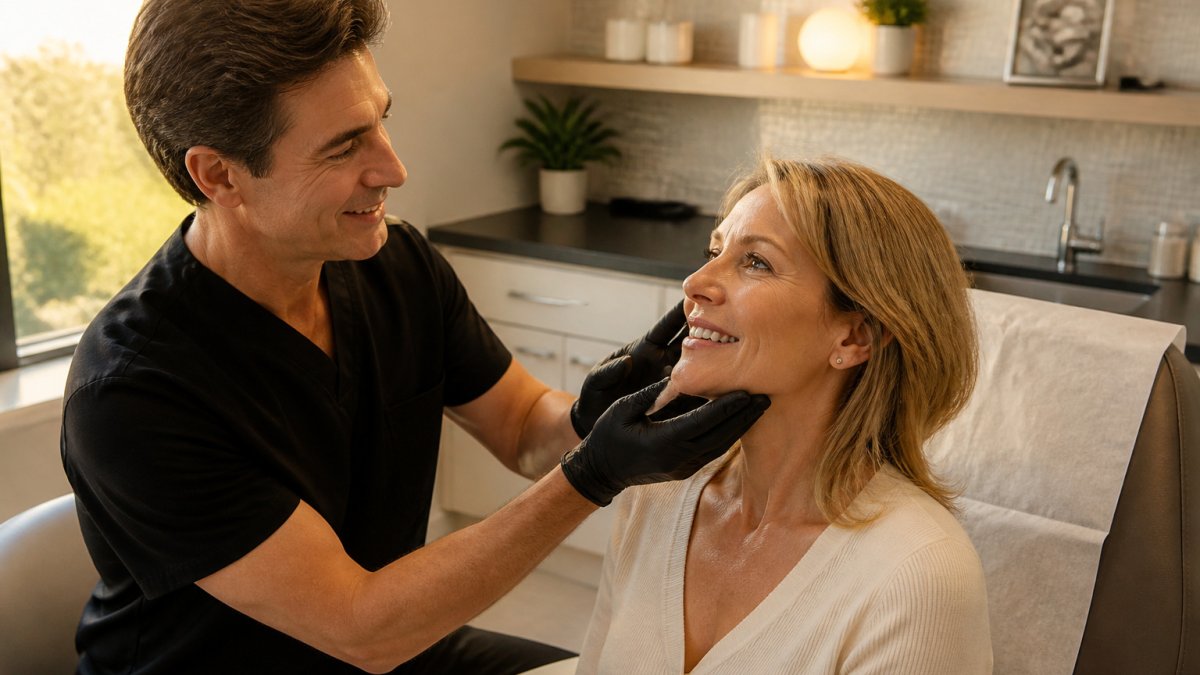
Recovery (downtime). This is the period of visible redness, swelling, or bruising after a session. Neuromodulators and most hyaluronic acid fillers typically involve little to no downtime, with minor pinpoint marks or mild swelling settling within a day or two. Biostimulators and deeper fillers can cause swelling that lasts a few days. Microneedling usually produces redness similar to a mild sunburn for one to three days. Non-ablative lasers often involve a few days of redness, while ablative resurfacing can involve a week or more of visible healing. Thread lifts commonly involve several days of swelling and mild discomfort.
Time to final result. This is how long it takes before you are seeing the treatment's full effect. Neuromodulators typically reach full effect in about 10 to 14 days. Hyaluronic acid fillers settle within roughly two weeks as swelling resolves. Biostimulators and collagen-stimulating treatments are the slowest, with improvement building over two to three months and sometimes up to six as collagen remodels. Energy-based tightening follows a similar curve, with gradual firming over two to six months. Laser resurfacing results continue to improve for several months as skin remodels.
Duration (longevity). This is how long the result holds once it has fully appeared, the ranges covered in the section above.
Why does the distinction matter? Because a treatment with a long duration can still have a slow onset, and a treatment with quick recovery can still have a short duration. A patient planning around an event, for example, needs to know that a biostimulator may not show its full benefit for months even though downtime is minimal, while a neuromodulator reaches full effect in about two weeks but fades in a few months.
Ask your provider to explain a timeline specific to your treatment. Early changes may be visible quickly, while final results often arrive later.
How to Maintain Facial Rejuvenation Results
Maintenance is usually planned in cycles. Your provider may recommend touch-up sessions at intervals that match the treatment type, such as neuromodulators every few months or collagen-stimulating sessions spaced over a year or more. Combining treatments thoughtfully, along with daily sun protection and a consistent skincare routine, helps extend results over time.
Booking Your Consultation at Bella MedSpa
Every face is different, so the most reliable way to learn how long your results may last is a personal consultation. At Bella MedSpa, our team can review your goals, explain realistic timelines, and outline a maintenance plan that fits your schedule. To ask about current pricing or availability, book a consultation with Bella MedSpa or learn how to choose a microneedling provider if that treatment interests you.
Non-surgical skin tightening results also follow a predictable pattern, which you can read about in our skin tightening results timeline. If you are weighing recovery against long-term benefit, a guide to laser resurfacing recovery signs at one month and how to decide whether microneedling is worth it for aging skin can help you plan.
Frequently Asked Questions
Do non-surgical facial rejuvenation results last as long as a facelift?
Generally, no. Non-surgical treatments such as injectables, radiofrequency and laser sessions typically produce results that last months to a few years, while a surgical facelift can last considerably longer, often several years to a decade or more depending on the individual. Results from either approach depend on age, skin quality, sun exposure and aftercare. A qualified clinician can help you compare options for your specific goals during a consultation at Bella MedSpa.
How long do skin-tightening results last?
Skin-tightening results vary by method. Some treatments produce gradual collagen changes that continue to develop over several months, and many patients maintain benefits for a period of one to two years or longer. Maintenance sessions are often recommended to sustain the effect. Your provider can outline a realistic timeline based on your skin condition and the treatment chosen.
What factors affect how long facial rejuvenation results last?
Several factors influence longevity, including the treatment type, your age, skin thickness and elasticity, sun exposure, smoking, sleep, weight changes and skincare habits. Consistent sun protection and a reliable skincare routine can help preserve results. Because individual responses differ, the duration you experience may be shorter or longer than general estimates.
How can you maintain facial rejuvenation results?
Maintenance usually combines scheduled follow-up treatments, daily sun protection, a consistent skincare routine and a healthy lifestyle. Many patients return for touch-up sessions every few months to a year, depending on the treatment. Your clinician can recommend a maintenance schedule that fits your goals and budget at your consultation.