 ultimate-guide
Dermal Fillers for Deep Nasolabial Folds: What to Expect
Last Updated: November 5, 2026
Quick Summary
Dermal fillers for deep nasolabial folds restore volume beneath the skin, lifting the crease from the inside rather than filling it from the surface. A skilled injector assesses your whole mid-face and may place structural support at the cheek, since overfilling the crease itself can look pillowed. Hyaluronic acid and calcium hydroxylapatite fillers are both used, and the right choice depends on what your fold needs.
- Deep nasolabial folds rarely have a single cause, and filler is not always the only answer.
- Hyaluronic acid fillers are reversible with hyaluronidase; calcium hydroxylapatite fillers have no dissolving agent.
- Hyaluronic acid filler longevity is typically 6 to 18 months depending on product and area.
- Swelling typically peaks on day 1 to 2, and the final result is usually visible by week 2 to 4.
- Contact your injector promptly for severe pain, skin color changes, vision changes, or worsening swelling.
Table of Contents
- Why Deep Nasolabial Folds Form (It Is Not Only Aging)
- How Dermal Fillers Soften Smile Lines and Laugh Lines
- Hyaluronic Acid vs. Calcium Hydroxylapatite Fillers for Nasolabial Folds
- Preparing for Dermal Filler Injections: A Step-by-Step Checklist
- What to Expect During Your Nasolabial Fold Filler Appointment
- Nasolabial Fold Filler Recovery Time and Post-Treatment Do's and Don'ts
- Nasolabial Fold Filler Side Effects and Safety Signals to Watch
- Book a Nasolabial Fold Filler Consultation at Bella MedSpa
- Frequently Asked Questions
Why Deep Nasolabial Folds Form (It Is Not Only Aging)
Deep nasolabial folds are the creases that run from the sides of the nose to the corners of the mouth, and they rarely have a single cause. At Bella MedSpa, we explain to patients that these folds are a structural feature of every face, not a defect. They become visible when volume shifts, skin changes, or bone support recedes.
Facial anatomy drives most of what you see. The mid-face loses fat pad volume over time, and that loss removes the cushioning that once kept the cheek smooth against the upper lip. Bone remodeling in the upper jaw and cheekbone adds to the effect. Even your sleeping position and repeated expressions play a role.
A common mistake is assuming filler is the only answer. Sometimes the fold is deep because the cheek above it has dropped, and treating only the crease can look flat or unnatural. That is why a proper assessment looks at the whole mid-face. If you want to see how other procedures address multiple signs of aging at once, our guide to procedures that take 10 years off your face is worth reading before you decide.
How Dermal Fillers Soften Smile Lines and Laugh Lines
Dermal fillers for deep nasolabial folds work by restoring volume beneath the skin, lifting the crease from the inside rather than filling it from the surface. A gel is placed in the subcutaneous layer or at the bone level, depending on what the fold needs. Smile lines and laugh lines soften because the tissue above them is supported again.
The injection technique matters more than the product name. A skilled injector maps the fold, decides whether the deficit sits deep or superficial, and chooses a needle or cannula accordingly. Some injectors use cannulas, which involve fewer needle punctures than sharp needles, and bruising risk varies by technique. Structural support placed at the mid-face often does more for a deep fold than product placed directly in the line.
What most guides miss is that overfilling the crease itself can create a heavy, pillowed look. Conservative, layered placement usually reads as natural. You can review the full range of dermal filler options on our dermal fillers service page to see what we offer.
Hyaluronic Acid vs. Calcium Hydroxylapatite Fillers for Nasolabial Folds
Two filler families are commonly used in this area, and they behave differently under the skin. Hyaluronic acid (HA) fillers are cross-linked gels that attract water and add soft volume. Calcium hydroxylapatite (CaHA) fillers are microspheres suspended in a gel carrier. Neither is universally better, the right choice depends on what the fold actually needs.
| Feature | Hyaluronic Acid | Calcium Hydroxylapatite |
|---|---|---|
| Consistency | Soft, flexible gel | Firmer, structural |
| Reversible | Yes, with hyaluronidase | No dissolving agent |
| Best for | Fine to moderate folds, first-time patients, patients who want reversibility | Deep folds needing structural support, patients with good skin thickness |
| Longevity | Typically 6 to 18 months depending on product and area | Often longer, with collagen stimulation continuing after the gel carrier absorbs |
| Placement depth | Superficial to deep, depending on product | Typically deeper, at the periosteum or deep subcutaneous layer |
Deep Folds vs. Fine Lines: Why the Distinction Matters
A deep nasolabial fold is not the same problem as a fine line, and treating them the same way is one of the most common reasons patients are disappointed. A fine line is a surface issue, a crease in the skin itself. A deep fold is usually a structural issue: the crease is deep because the cheek above it has lost volume, the bone underneath has remodeled, or both. Filling a deep fold with a soft product placed superficially can leave the crease looking pillowed or can make the mid-face look flat rather than lifted.
A layered plan is one approach some injectors use for deep folds, with the specific plan determined at consultation. Fine lines around the mouth are handled differently, usually with a softer HA product or a skin-resurfacing approach rather than deep structural filler.
Matching the Product to the Fold
A few practical patterns guide product selection for this area:
Watch out: a product marketed as "best for nasolabial folds" is not a treatment plan. The same fold can call for different products in different patients depending on bone support, fat pad volume, and skin quality, and a provider who uses one product for every fold is not assessing anatomy.
If you are weighing how long results last across non-surgical options, our non-surgical skin tightening results timeline walks through what to expect.
Preparing for Dermal Filler Injections: A Step-by-Step Checklist
Preparing for dermal filler injections is mostly about setting realistic expectations. Plan ahead and the appointment runs smoother.
Choosing a qualified injector is the single most important step. Our guide on how to choose a qualified injector covers the credentials and questions that matter before you book.
What to Expect During Your Nasolabial Fold Filler Appointment
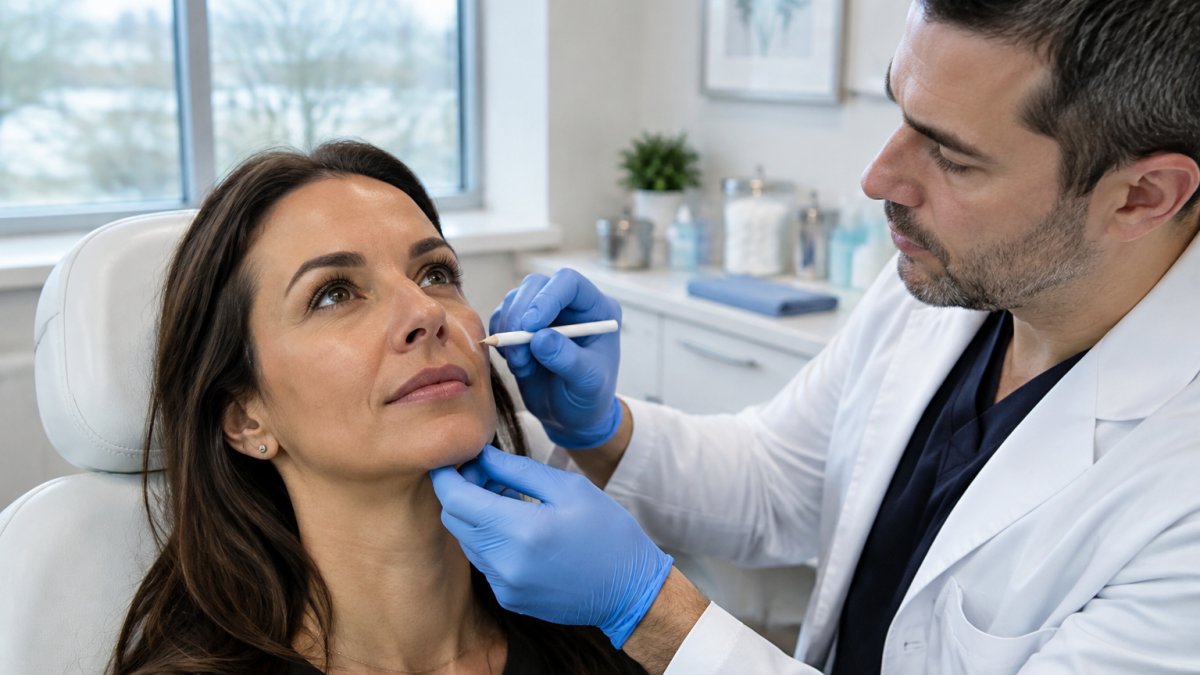
A nasolabial fold filler appointment includes consultation, cleansing, and numbing. Your injector assesses your facial anatomy, marks the treatment zones, and applies topical anesthetic. Most patients describe the injections as brief pressure rather than sharp pain.
The woman is American.
Placement follows the plan made during assessment. Your injector may treat the mid-face first, then the fold, checking symmetry as they go. You will likely see an immediate change, though swelling will affect the final look.
Nasolabial Fold Filler Recovery Time and Post-Treatment Do's and Don'ts
Nasolabial fold filler recovery time varies between people. Mild swelling and redness often settle within a few days. Bruising, when it happens, can take a week or more to fade. Knowing what is normal at each stage makes it easier to tell a routine recovery from something that needs a call to your injector.
Recovery Timeline: What to Expect Day by Day
- First 2 to 4 hours: Mild swelling, tenderness, and occasional pinpoint bruising at injection sites. Some patients see a small raised area at each injection point; this usually settles within a day.
- Day 1 to 2: Swelling typically peaks. The treated area may feel firm or slightly lumpy to the touch, which is expected as the product settles.
- Day 3 to 7: Swelling resolves, bruising fades from purple to yellow, and the result begins to look more like the final outcome.
- Week 2 to 4: Any residual firmness softens, and the final result is usually visible. This is the point at which a follow-up assessment makes sense if anything looks asymmetric.
The First 48 Hours: A Do's and Don'ts Checklist
Do:
Watch out: pressing or massaging the treated area against instructions can shift product and increase the chance of asymmetry, if you are unsure whether massage is part of your plan, ask before you leave the office rather than guessing at home.
When to Call Your Injector
Contact your provider promptly if you notice severe pain, changes in skin color, vision changes, or swelling that worsens instead of improving.
If you want realistic expectations on how long results hold, read our guide on how long facial rejuvenation lasts.
Nasolabial Fold Filler Side Effects and Safety Signals to Watch
Common nasolabial fold filler side effects include swelling, bruising, tenderness, and small lumps at injection sites. These often resolve on their own. Less common risks include asymmetry, migration of product, and infection.
Rare but serious is vascular occlusion, where filler blocks a blood vessel. Warning signs include severe pain, blanching of the skin, and a mottled or dusky color. Seek urgent care from your injector immediately if these appear; hyaluronidase can reverse hyaluronic acid filler when given promptly.
Choosing a qualified practitioner who understands facial anatomy is an important consideration, but risks are not eliminated. The U.S. Food and Drug Administration provides safety information on dermal fillers, and the American Society of Plastic Surgeons offers guidance on selecting a qualified provider. Always disclose your medical history during consultation.
Book a Nasolabial Fold Filler Consultation at Bella MedSpa
Deciding on dermal fillers for deep nasolabial folds is easier with an honest assessment from a trained eye. At Bella MedSpa, our team, led by Dr. Craig Schacher, MD, FACEP, offers a comprehensive range of facial rejuvenation services and a personalized approach to medical aesthetics in a professional environment.
Every patient deserves to feel confident in their own skin, and a consultation is the right place to start. New patients can book now to discuss their options with our team.
Frequently Asked Questions
What are the downsides of getting nasolabial fold fillers?
The main downsides are temporary bruising, swelling, and tenderness around the injection sites, which usually settle within a few days. Less common risks include asymmetry, lumps, or filler migration if the product is placed too superficially. Rare but serious complications such as vascular occlusion require immediate medical attention. Deep folds may also need more than one session to reach the desired correction.
How long do dermal fillers typically last in the nasolabial folds?
Longevity depends on the filler type, the depth of placement, and your metabolism. Longevity varies by filler type and individual, and your provider can discuss expected duration. Areas with constant movement, like the smile lines, tend to break down filler faster than quieter zones.
What should I expect during a nasolabial fold filler consultation?
A consultation usually includes a review of your health history, a facial anatomy assessment, and a discussion of your goals. Your provider will examine the fold depth, skin elasticity, and mid-face support, then explain which filler type and injection technique suit you. You may wish to ask a provider about their credentials, expected downtime, side effects, and aftercare. Bringing a list of medications and prior treatments helps the provider plan safely.
How do I choose the right provider for facial injectables?
Look for a board-certified physician or a licensed clinician working under medical supervision, and ask about their specific training in facial anatomy and injection technique. A good provider reviews your history and explains risks honestly. You may wish to ask to see before-and-after photos of similar patients and confirm the products used are FDA-approved. A thorough consultation matters more than a low price.