 how-to
How to Treat Hyperpigmentation on Face: A Complete Guide
Table of Contents
- Understanding Hyperpigmentation: What Causes Dark Spots
- Best Ingredients for Hyperpigmentation in Your Skincare Routine
- How Long Does Hyperpigmentation Take to Fade with Treatment
- Professional Laser Treatment for Dark Spots and Discoloration
- Building a Complete Routine to Treat Hyperpigmentation on Face
- Sun Protection and Photoprotection: The Non-Negotiable Step
- Skin-Tone Considerations and Managing Expectations
- Frequently Asked Questions
Last Updated: September 30, 2026
Understanding Hyperpigmentation: What Causes Dark Spots
Hyperpigmentation is the darkening of skin caused by excess melanin production. It appears as patches, spots, or uneven tone on the face. Understanding what triggers these changes is the first step in learning how to treat hyperpigmentation on face effectively.
Dark spots result from specific skin conditions and environmental factors. Two main types dominate: post-inflammatory hyperpigmentation and melasma, each requiring a different approach.
Post-Inflammatory Hyperpigmentation vs. Melasma
Post-inflammatory hyperpigmentation (PIH) develops after skin injury or inflammation from acne, eczema, or aggressive treatments. PIH usually fades on its own within 6 to 12 months.
Melasma is different. It's a chronic condition marked by symmetric brown patches, typically on the cheeks, forehead, or upper lip. Melasma develops from a combination of genetics, sun exposure, and hormonal changes. It's more stubborn and requires consistent treatment to improve.
How Sun Damage and Melanin Production Trigger Discoloration
Sun exposure is the primary driver of both conditions. UV rays stimulate melanin production as a protective response, which over time becomes visible as dark spots and patches.
Melanin production happens in melanocytes in the basal layer of your epidermis. When UV light hits, melanocytes increase output to shield deeper skin layers, leading to uneven distribution as some areas produce more melanin than others.
With age, your skin's ability to regulate melanin declines, cell turnover slows, and dead cells accumulate, trapping pigment near the surface.
Best Ingredients for Hyperpigmentation in Your Skincare Routine
The right ingredients interrupt melanin production and speed cell turnover. Some block the enzyme that creates melanin; others promote exfoliation to shed pigmented cells faster. Combining multiple actives without understanding their interactions stalls results and damages the skin barrier.
Vitamin C and Retinol: Tyrosinase Inhibitors That Work
Vitamin C is a proven tyrosinase inhibitor, the enzyme responsible for melanin synthesis. Blocking it slows melanin production while boosting collagen and protecting against future sun damage.
Retinol accelerates cell turnover, pushing pigmented cells to the surface faster, and stimulates collagen remodeling to improve skin texture alongside brightening.
Start with lower concentrations (0.25-0.5% retinol) if your skin is sensitive. Increase gradually. Use retinol at night only; it increases sun sensitivity.
Hydroquinone, Kojic Acid, and Mandelic Acid: Prescription and OTC Options
Hydroquinone is the gold standard for treating melasma. It's a potent tyrosinase inhibitor available in 2-4% over-the-counter formulas and up to 8% by prescription. Results typically appear within 4-6 weeks of consistent use.
Kojic acid is a gentler alternative. It inhibits tyrosinase and has anti-inflammatory properties. Kojic acid works well for mild to moderate hyperpigmentation and suits sensitive skin types.
Mandelic acid is an alpha hydroxy acid (AHA) derived from almonds. It exfoliates gently while brightening. Mandelic acid is larger than other AHAs, so it penetrates slowly and causes less irritation. It works particularly well for darker skin tones.
Natural Brightening Agents: Licorice Root Extract and Tranexamic Acid
Licorice root extract contains glabridin, which inhibits melanin production and calms inflammation, making it gentler than hydroquinone and suitable for sensitive skin.
What NOT to Mix: Ingredient Interactions and Safety
Do not mix retinol with AHAs or BHAs on the same night. Both increase cell turnover aggressively. Combined, they cause excessive dryness, redness, and peeling that can trigger post-inflammatory hyperpigmentation, the very condition you're trying to treat. Use retinol on Monday, Wednesday, and Friday nights; reserve AHA/BHA for Tuesday and Thursday if you want both in your routine.
How Long Does Hyperpigmentation Take to Fade with Treatment
Post-inflammatory hyperpigmentation fades faster than melasma, which can take 3-6 months of consistent treatment to show meaningful improvement.
Professional Laser Treatment for Dark Spots and Discoloration
Lasers emit light wavelengths that melanin absorbs, breaking apart pigment particles that your body then clears naturally.
How Laser Therapy Targets Melanin in the Epidermal and Dermal Layers
Shorter wavelengths (like 532nm) target epidermal melanin, while longer wavelengths penetrate deeper to reach dermal pigment.
Chemical Peels, Microneedling, and Advanced Options
Chemical peels use acids to dissolve outer skin layers. Stronger peels penetrate deeper and produce faster results but require longer recovery; medium-depth peels balance results with downtime.
Building a Complete Routine to Treat Hyperpigmentation on Face
Learning how to treat hyperpigmentation on face requires a three-step system: cleanse, treat, protect. Each step matters equally. Skip one, and results stall.
Step 1: Cleanse and Exfoliate for Cell Turnover
Use a gentle cleanser twice daily and avoid scrubs, which worsen melasma and post-inflammatory hyperpigmentation.
Step 2: Apply Active Brightening Ingredients
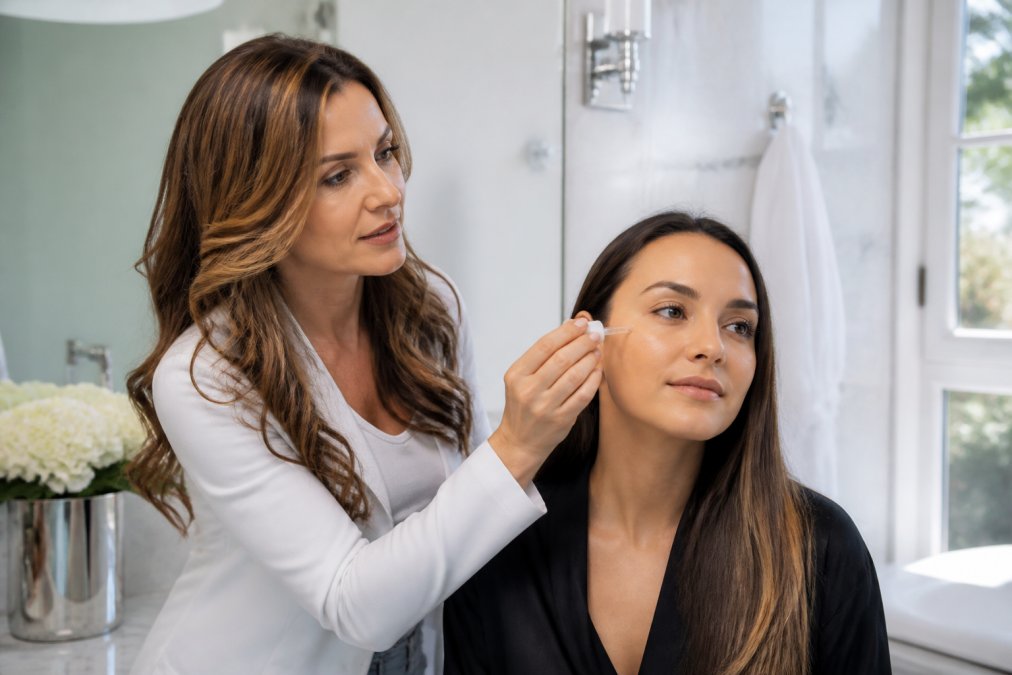
Apply serums to clean, dry skin, waiting 2-3 minutes between products for proper absorption.
Step 3: Support Your Skin Barrier and Maintain Consistency
Moisturize immediately after serums to lock in hydration and support skin barrier health, as brightening ingredients can be drying.
Sun Protection and Photoprotection: The Non-Negotiable Step
Sun protection determines whether treatment succeeds or fails. Even one unprotected day undoes weeks of treatment progress.
Skin-Tone Considerations and Managing Expectations
Hyperpigmentation treatment outcomes and safety profiles vary significantly by skin tone. Darker skin tones (Fitzpatrick types IV-VI) are more prone to melasma and post-inflammatory hyperpigmentation because melanocytes respond more aggressively to inflammatory triggers, hormonal shifts, and sun exposure.
How Hyperpigmentation Manifests Differently Across Skin Tones
On lighter skin (Fitzpatrick I-III), hyperpigmentation appears as discrete brown spots or patches with clear borders, fading relatively quickly within 6-12 months as underlying inflammation resolves faster.
Laser and Professional Treatment Safety by Skin Tone
Shorter-wavelength lasers (532nm and 1064nm Nd:YAG) can cause paradoxical darkening, rebound melasma, if melanin is not precisely targeted, stimulating melanocytes rather than destroying pigment.
For Fitzpatrick IV-VI skin:
- Nd:YAG lasers (1064nm) penetrate deeper and bypass surface melanin, targeting dermal pigment directly with lower risk of rebound darkening.
- Microneedling is an excellent alternative for all skin tones, triggering collagen remodeling without targeting melanin directly, requiring 3-4 sessions spaced 4-6 weeks apart.
- Chemical peels using mandelic or lactic acid are gentler than glycolic acid and produce reliable results without laser's darkening risk. Medium-depth peels (20-30% mandelic acid) work well; avoid phenol peels.
- Combination treatments pairing microneedling with topical brightening serums enhance results without added risk.
Ingredient Selection by Skin Tone
Mandelic acid (AHA) is larger and penetrates more slowly than glycolic acid, making it gentler while still effective. Use 2-3 times weekly.
Realistic Expectations by Skin Tone and Condition Type
Post-inflammatory hyperpigmentation on darker skin: Expect 50-70% improvement over 6-12 months with consistent topical treatment and sun protection. Professional treatments can accelerate this to 3-6 months.
A practitioner familiar with your skin tone can recommend the safest and most effective combination of treatments, avoiding trial-and-error that delays results.
Frequently Asked Questions
What are the most effective ingredients to treat hyperpigmentation on face?
Vitamin C, retinol, hydroquinone, and kojic acid are among the most clinically proven brightening agents. Vitamin C works as a tyrosinase inhibitor to reduce melanin production, while retinol accelerates cell turnover. Hydroquinone is prescription-grade and highly effective for stubborn dark spots. For milder cases, mandelic acid and licorice root extract offer gentler exfoliation and brightening without irritation. Combining complementary ingredients often yields faster results than using one alone.
How long does hyperpigmentation take to fade with professional treatment?
Results depend on the treatment type and severity. Topical skincare ingredients typically show visible improvement in 6-12 weeks with consistent use. Professional laser therapy for dark spots often requires 3-5 sessions spaced 4-6 weeks apart, with noticeable fading after the first or second session. Chemical peels and microneedling show results within 2-4 weeks. Post-inflammatory hyperpigmentation may fade faster (4-8 weeks) than melasma (3-6 months or longer). Patience and sun protection are essential throughout the process.
Can I combine multiple active ingredients to treat hyperpigmentation faster?
Yes, but with caution. Layering complementary ingredients like vitamin C with retinol or mandelic acid with hydroquinone can enhance results. However, combining too many actives or using them incorrectly can damage your skin barrier and cause irritation. Start with one ingredient, introduce a second after 2-3 weeks, and always use broad-spectrum sunscreen daily. A dermatologist or medical aesthetician can recommend a safe combination tailored to your skin type and concerns.
Does sun exposure worsen hyperpigmentation?
Yes, UV exposure significantly worsens hyperpigmentation by stimulating melanin production and darkening existing discoloration. Sun damage is a primary cause of melasma and can trigger post-inflammatory hyperpigmentation to persist longer. Daily broad-spectrum sunscreen (SPF 30 or higher) is non-negotiable when treating dark spots, without it, even the most effective treatments will show limited results. Reapply every two hours, especially during peak sun hours, and consider protective clothing or hats for additional photoprotection.